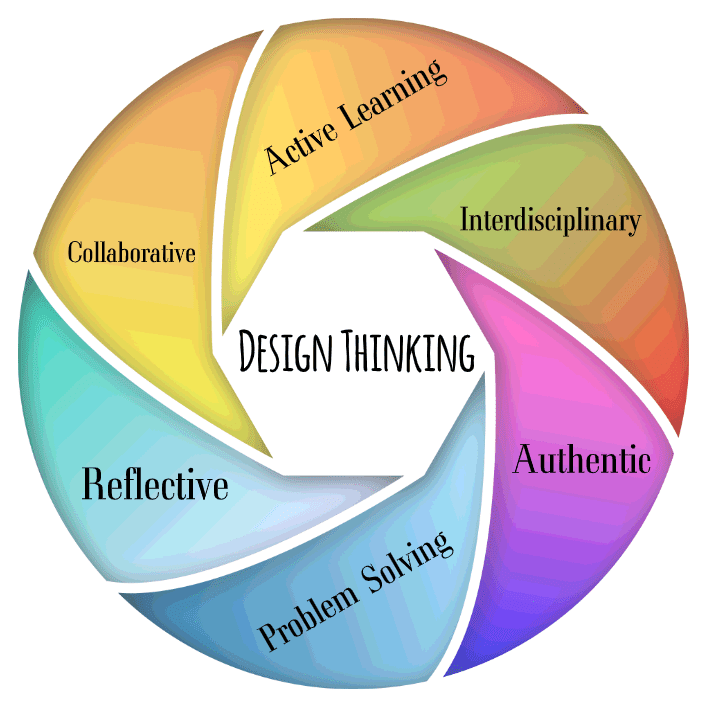
“Design thinking is a structured approach for human-centered, creative problem-solving that follows an interdisciplinary and collaborative approach where disparate perspectives are encouraged. The intent of design thinking is for participants to learn their way into a solution by understanding the needs of those who will ultimately use the solution being designed, brainstorming and prototyping ideas, and revising until a final product or model is established” (Warman, Greg & EDUCAUSE, 2014).
Design thinking is much like life itself. The intention is to work through the steps in order, but your experience may take you on several paths to completion. Teams work through five stages to find a solution. With this non-linear process, you may go back to previous steps in order to clarify or redefine before continuing to move forward. The only requirement is to begin with the empathy stage. In working through the process, the designer learns to understand the target audience (empathy); articulate the problem (define); think of a solution (ideate); create a product or solution (prototype); and apply the prototype (test).
What’s Next
The first step in our journey will be exploring the 5 stages and learning a strategy to help us solve the problem. Next, this eLearning module will explore teaching strategies and then explore GMU as well as design thinking professional resources.
Tell us something that you learned about design thinking and what you hope to learn in the rest of this module in the reply box below.
“As a human-centered designer you need to understand the people for whom you are designing. The problems you are trying to solve are rarely your own—they are those of particular users; in order to design for your users, you must build empathy for who they are and what is important to them” (d school Stanford University, 2020).
Our first step is to understand out target audience. To do this, our strategy will be to complete an empathy map. This strategy separates emotions and feelings for us to better understand the user.
When completing the map, listen to the person you are interviewing and write down:
What the user did, thought, felt, and said. What did you see and hear Afterwards, reflect and think about their pains and gains.
Activity
Let’s complete an empathy map! You will read a scenario and learn what the four users are feeling. Please use this empathy map template. You may complete one map outlining all four people or complete one map per person. Save the maps as you will need to reference on the next step. If you are working with a partner, you may complete one set of map/s.
Design Challenge
Interim President Anne Holton announced the creation of the Tiger Team to advise the administration how to reopen George Mason University. In addition to safety concerns, student morale is low due to the stress from the abrupt move to online learning as well as disruptions in family and work life. Recent Facebook posts and a student quoted in the NY Times have made the committee aware of the need to reengage students and get them motivated to return in the fall. You have been appointed to a sub-committee to address these issues. Read the comments below. How does the administration address getting students excited about studying at GMU in the fall? What can Mason do immediately and when the students return?
Facebook posts
Please note, these are unedited and real FB posts.
Concerned parent “I hope GMU is looking forward to next semester and figuring out how to go back to normal classes or they will lose many students including our daughter…online is not the answer and not what we paid for! I listen to my daughter complain almost everyday about how bad the instructions are…cancelling classes with zero advance notice but expect material to be learned on student’s abilities. The professors are not responsive to her emails. We will not pay out of state level tuition for sub-par learning and poor instructional classes! Please find a way because our daughters loves GMU! Refocus on your students!”
FB Student 1 “As much as important to stay at home right now but what you said is so true. Base your my experience with GMU during COVID 19, some professors don’t know how to manage online classes and the transition from in class to online was very difficult to adjust! In one particular case my professor’s grading scale changed so bad that could effects everyone’s grade dramatically. I complained to her and she even ignored my email for couple days then answered in a brief email without pinpointing my concerns. And there is no place to send your complain. It’s very frustrating.”
FB Student 2 “The coronavirus has changed almost every aspect of our lives at Mason. Classes are now online, no more eating at the dining hall, no walking across the stage in May at EagleBank Arena during graduation — all while we hear of the thousands of people who are ill and dying around the country and the world.It’s scary. But we can do something to help stop the spread of the virus. Practice social distancing. Don’t gather in groups, avoid crowds, and whoever you are with, stay at least six feet away. Because even if you are not showing symptoms you can still have and spread illness. As college students, we are not immune nor are we invincible. Reports say 48 percent of those with the virus are between the ages of 20 and 54. Though most people who get coronavirus recover and many people have mild symptoms, if you feel sick, it is important to stay home, except to get medical care! Social distancing will protect you and your families, and those whose compromised immune systems might not be able to fight the disease. Flatten the curve. Mason Nation, we can do this together.”
NY Times interviewed student “Things are much more self-managed. My emotions toward school range from feeling unmotivated to writing shadow letters to my professors apologizing for my lack of focus. I have always loved school, but this doesn’t feel like learning. My professors try to create normalcy, but there is none.” (New York Times, 2020)
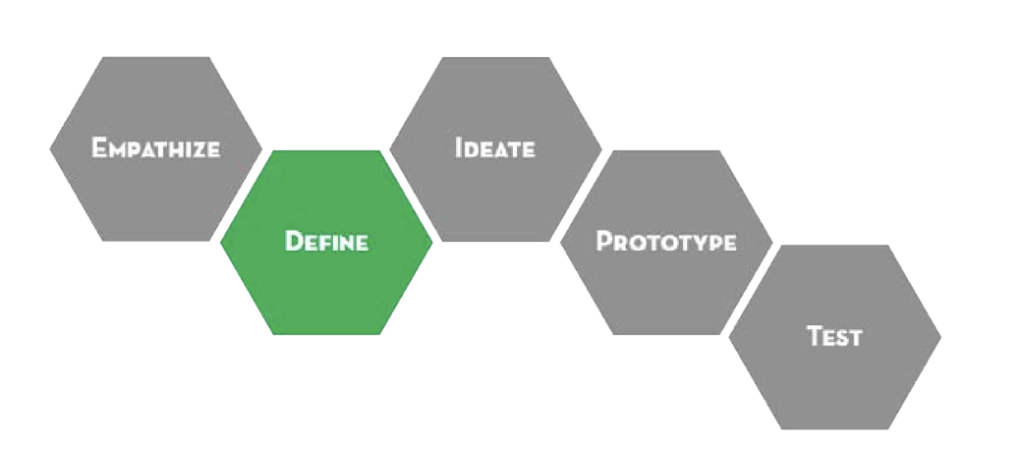
“The define mode is when you unpack and synthesize your empathy findings into compelling needs and insights, and scope a specific and meaningful challenge. It is a mode of “focus” rather than “flaring.” Two goals of the define mode are to develop a deep understanding of your users and the design space and, based on that understanding, to come up with an actionable problem statement: your point of view” (d school Stanford University, 2020).
In our next activity, The 5 Whys will help you get to the root cause and be able to define your point of view.
Consulting your empathy maps, define the problem by doing the 5 Whys. The root question will be: Why are students at GMU unhappy? Ask “why” and “because” on each step. Afterwards, define the problem from your point of view. You may work with a partner or alone.
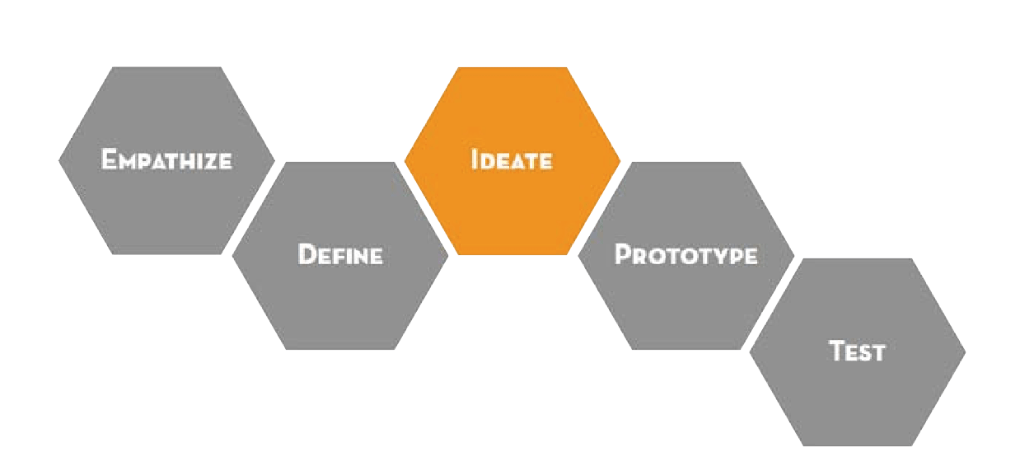
“You ideate in order to transition from identifying problems into exploring solutions for your users. Various forms of ideation are leveraged to: • Step beyond obvious solutions and thus increase the innovation potential of your solution set • Harness the collective perspectives and strengths of your teams Uncover unexpected areas of exploration • Create fluency (volume) and flexibility (variety) in your innovation options • Get obvious solutions out of your heads, and drive your team beyond them” (d school Stanford University, 2020).
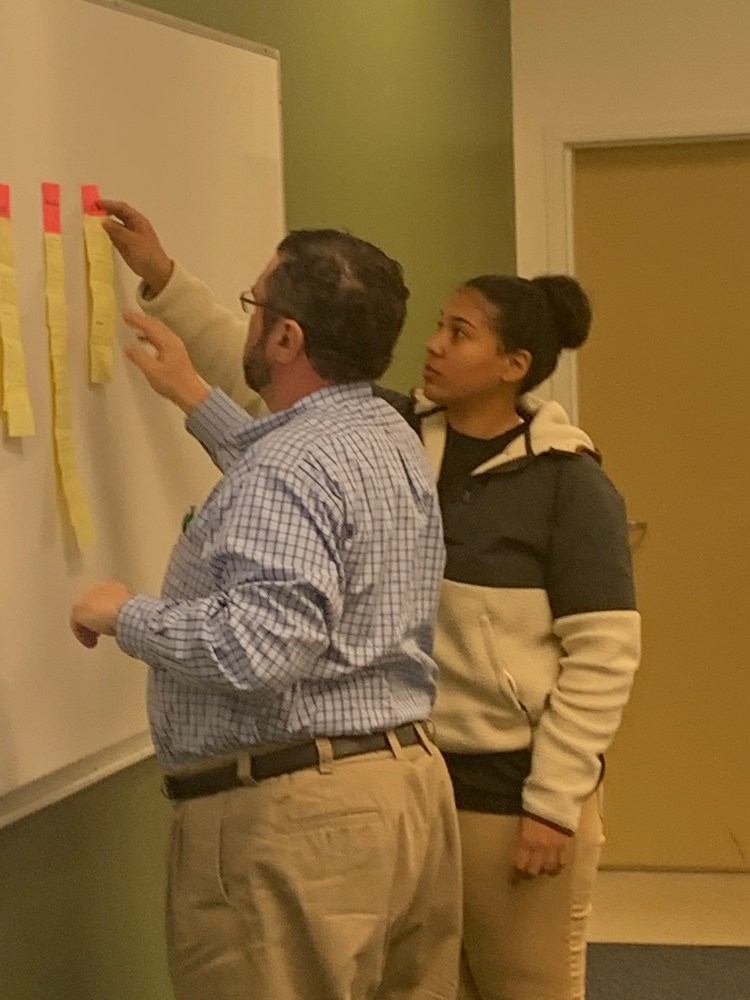
Rosemary Pinales and Jeff Prater complete a storyboard
Activity
You will do an activity called Brainwrite.
Step one: For the first three minutes, write down as many ideas as you can about how to solve the problem you defined.
Step two: Pass your answers to your partner. Read his/her ideas and for 3 minutes, write down more ideas you have building upon their answers. If you are working alone, consult the other answers in the blog.
Step three: For 3 minutes, discuss the answers on both of your sheets. Agree to a list of five ideas to solve the problem.
What were your top five ideas for solving your defined problem? Write a reply below.
“Traditionally prototyping is thought of as a way to test functionality. But prototyping is used for many reasons, including these (non-mutually-exclusive) categories: • Empathy gaining: Prototyping is a tool to deepen your understanding of the design space and your user, even at a pre-solution phase of your project. • Exploration: Build to think. Develop multiple solution options. • Testing: Create prototypes (and develop the context) to test and refine solutions with users. • Inspiration: Inspire others (teammates, clients, customers, investors) by showing your vision” (d school Stanford University, 2020).
Activity
In this activity, you will do Gut check.
Step one: Take five minutes and outline a plan to solve our original questions. Use the top five ideas from our Brainwrite activity in Module 4 to create the plan.
Original question from the Tiger Team: How does the administration address getting students excited about studying at GMU in the fall? What can Mason do immediately and when the students return?
Step two: What kinds of obstacles stand in your way of achieving your plan? Write your answer in the blog.
What kind of obstacles get in your way? Do you feel that you may need to revisit a previous stage? Write your answer in the reply box below.
“Testing is the chance to get feedback on your solutions, refine solutions to make them better, and continue to learn about your users. The test mode is an iterative mode in which you place your low-resolution artifacts in the appropriate context of the user’s life. Prototype as if you know you’re right, but test as if you know you’re wrong” (d school Stanford University, 2020).
Activity
In the blog, tell me how would you test your plan seeking approval from students and administrators.
Share how you would you test your plan to seek approval from students and administrators? Write your reply below
Facial shields made by the Mason team are being put to good use. The first set was delivered to medical professionals at Elmhurst Hospital in Queens, N.Y. (Photo, George Mason University)
Promoting student innovation and entrepreneurship
Mason is a university dedicated to innovation. We make the news regularly for our research efforts benefitting the community, including students making face shields for frontline healthcare workers and faculty contributing to COVID-19 investigation. The spirit carries over with our famous food delivery robots from a third-party vendor.
The Stearns Center for Teaching and Learning offers more opportunities to collaborate and apply design thinking. Faculty can develop active learning and student engagement skills through online resources, workshops, and individual consultation. In addition, the Stearns Center offers a yearly conference showcasing exemplary work of Mason faculty called Innovations in Teaching & Learning (ITL). Collaborate with the Stearns Center for implementing design thinking into your lessons and submit a proposal to present at the conference!
Design thinking minor
At George Mason University, design thinking is the first interdisciplinary minor with two tracks and is in its second year. Faculty representatives from all six colleges serve on the committee. Undergraduate students from any major may declare the minor.
The Design Thinking Minor is an 18 credit minor with three required interdisciplinary courses: DSGN 101, DSGN 102, and DSGN 401 (capstone course), and two tracks: (1) Design in the Built Environment and (2) User Experience Design (UXD). Students select one track and take nine credits of coursework within the chosen track.
The Design Thinking Minor had activities planned but canceled due to COVID-19. Check the website for the future faculty development workshop and “student Designathon.”
STRATEGIC GOAL #1: INNOVATIVE LEARNING Deliver a transformative Mason Learning Experience that is experiential, global, and technology rich.
Metric #1: 100% of Mason undergraduate students will graduate with transformative Mason Impact experiences, incorporating at least one of the following: undergraduate research or creative project, civic engagement project, entrepreneurial experience, global education experience, clinical experience, student teaching, internship, and/or capstone course.
Metric #2: 90% of graduating seniors will meet or exceed benchmarks on learning outcomes in critical thinking, problemsolving, and communication.
Metric #3: 30% of all classrooms will be Active Learning Classrooms, and every undergraduate student (excluding fully online students) will take at least one course taught in an Active Learning Classroom.
STRATEGIC GOAL #9:SUPPORT TEACHING AND FACULTY EXCELLENCE Mason will provide an environment and resources to support faculty and encourage academic innovation and excellence.
Metric #3: 100% of all faculty members will participate in at least one professional development activity annually that supports their teaching and learning, research and scholarship, writing, mentoring, or other career-related goals.
STRATEGIC GOAL #11: RESEARCH OF CONSEQUENCE Enhance Mason research in domains of great academic, societal, and economic consequence.
Metric #4: Identify 10-year horizon, multidisciplinary teams to enhance Mason’s competitive advantage in research, scholarship, and creative activities in the 2024-34 period and establish at least five related transdisciplinary centers.
Metric #7: Double the number of faculty members who are engaged in collaborative community-based research, or clinical or professional training programs that have economic or social impact on community partners (George Mason University, 2020d).
Explore the campus workspaces described in this module. How can they assist you in implementing design thinking specifically? Write your reply below.
Evidence-based research provides proven suggestions to consider. Gachago et al., 2017 and d school Stanford University, 2020 emphasize creating an emotionally supportive and non-judgmental atmosphere to encourage learning. Students need to explore and refocus after an idea fails. The instructor is key in motivating the student to try again. Furthermore, preparation is necessary prior to starting a design thinking lesson. Gachago et al., 2017 suggest preparing students for creative problem solving through activities that are active and emphasize learning by doing. Demonstration or observation do not work well in preparing students for design thinking.
Instructors can have success in teaching design thinking both online and face-to-face. Instructors should address the following issues in preparation for implementing design thinking.
Prepare a good problem statement using clear language in order to challenges the student to explore a solution.
Encourage the students to discover and explain their solutions using storytelling.
Encourage the students to explore and fail in order to develop problem solving skills.
Provide scaffolding through productive dialogue in order to teach problem solving skills.
Costa, K. (2017). Seven strategies to apply design thinking in higher education. Enrollment Management Report, 21(4), 8–9. https://doi.org/10.1002/emt.30311
Gachago, D., Morkel, J., Hitge, L., van Zyl, I., & Ivala, E. (2017). Developing eLearning champions: A design thinking approach. International Journal of Educational Technology in Higher Education, 14(1), 30. https://doi.org/10.1186/s41239-017-0068-8
Lloyd, P. (2013). Embedded creativity: Teaching design thinking via distance education. International Journal of Technology and Design Education, 23(3), 749–765. https://doi.org/10.1007/s10798-012-9214-8
Complete this worksheet: Framing Your Challenge(IDEO.org, 2015) and email it to us. This submission will complete the training and we will email your certificate upon verification of participation in the activities.







 Design Thinking e-learning module for GMU faculty