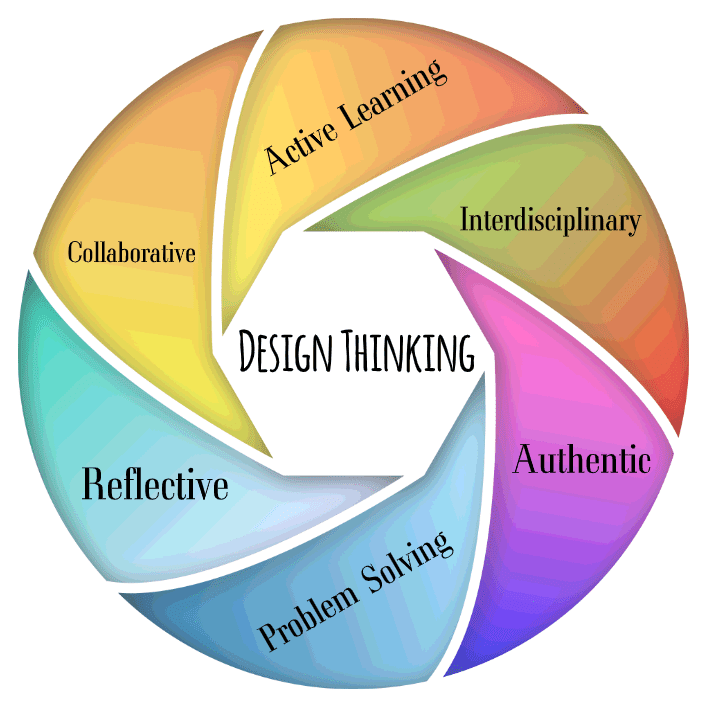
Implementing Design Thinking in your classroom
Evidence-based research provides proven suggestions to consider. Gachago et al., 2017 and d school Stanford University, 2020 emphasize creating an emotionally supportive and non-judgmental atmosphere to encourage learning. Students need to explore and refocus after an idea fails. The instructor is key in motivating the student to try again. Furthermore, preparation is necessary prior to starting a design thinking lesson. Gachago et al., 2017 suggest preparing students for creative problem solving through activities that are active and emphasize learning by doing. Demonstration or observation do not work well in preparing students for design thinking.
Instructors can have success in teaching design thinking both online and face-to-face. Instructors should address the following issues in preparation for implementing design thinking.
- Prepare a good problem statement using clear language in order to challenges the student to explore a solution.
- Encourage the students to discover and explain their solutions using storytelling.
- Encourage the students to explore and fail in order to develop problem solving skills.
- Provide scaffolding through productive dialogue in order to teach problem solving skills.
Resources
Instructional Materials
d school Stanford University. (2018). Design Thinking Bootleg. Stanford d.School. https://dschool.stanford.edu/resources/design-thinking-bootleg
d school Stanford University. (2020). Design Thinking Bootcamp Bootleg. Stanford d.School. https://dschool.stanford.edu/resources/the-bootcamp-bootleg
IDEO.org. (2015). Design Kit. IDEO.org. https://www.designkit.org/resources/1
Cases studies and examples
UX Design Courses & Global UX Community. (2020). The Interaction Design Foundation. Retrieved May 11, 2020, from https://www.interaction-design.org/
Other Universities that use design thinking
Universities—University Innovation Fellows. (2015). Retrieved May 11, 2020, from https://universityinnovation.org/wiki/Category:Universities
Evidenced-based research
Costa, K. (2017). Seven strategies to apply design thinking in higher education. Enrollment Management Report, 21(4), 8–9. https://doi.org/10.1002/emt.30311
Gachago, D., Morkel, J., Hitge, L., van Zyl, I., & Ivala, E. (2017). Developing eLearning champions: A design thinking approach. International Journal of Educational Technology in Higher Education, 14(1), 30. https://doi.org/10.1186/s41239-017-0068-8
Lloyd, P. (2013). Embedded creativity: Teaching design thinking via distance education. International Journal of Technology and Design Education, 23(3), 749–765. https://doi.org/10.1007/s10798-012-9214-8
Warman, Greg, & EDUCAUSE. (2014, June 3). 7 Things You Should Know About Design Thinking. https://library.educause.edu/resources/2014/6/7-things-you-should-know-about-design-thinking
Last activity
Complete this worksheet: Framing Your Challenge (IDEO.org, 2015) and email it to us. This submission will complete the training and we will email your certificate upon verification of participation in the activities.
 Design Thinking e-learning module for GMU faculty